|
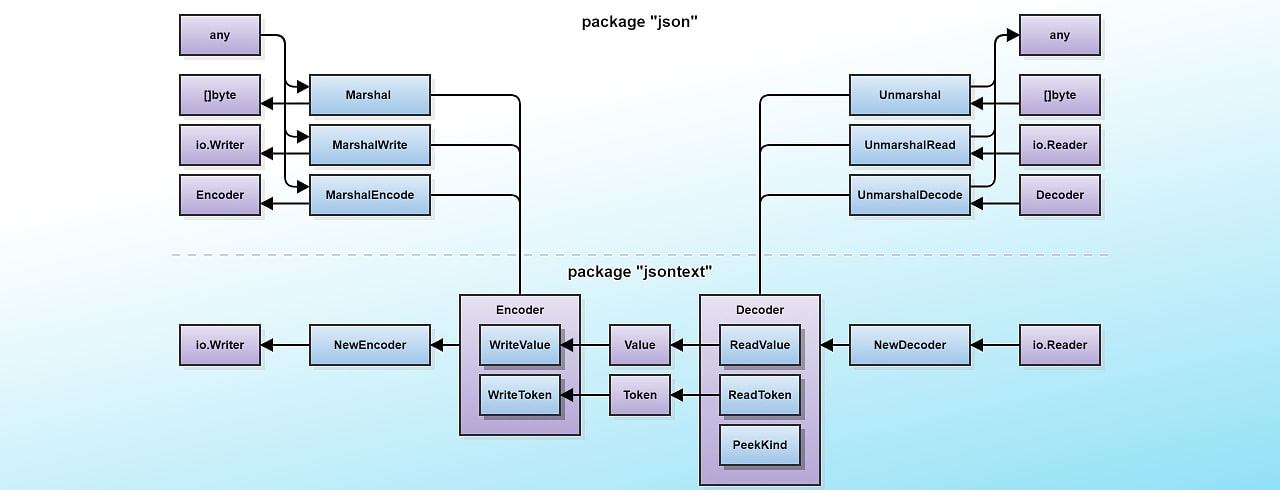
The Official Guide to encoding/json/v2 (and Migrating to It) — Now that encoding/json/v2 and jsontext are stable, the Go team has a refreshed introduction to how they work, including how v1 and v2 interoperate. There's also a new migration guide which shows off jsonsplit for running v1 and v2 side by side in production and logging any differences.
Pratt, Tsai, Martí et al. (Go Team)
|
💡 Lleg put v2 to the test and found nine default behavior changes, 10% faster unmarshaling on plain structs, and big perf gains for deeply recursive custom decoders. |

What Happens to Your go func() When the Pod Restarts? — Whatever it was doing is gone: you lose the email being sent or the webhook call. Go Event-Driven, the hands-on training from Watermill's authors, starts with goroutines and ends with Go services where data survives a restart. Don’t miss the last cohort this year that opens November 11.
Three Dots Labs
|
|
How //go:embed Works: From Source Files to Binary — A guided tour of how an embedded file travels through the toolchain, with links to the Go source for each step. Along the way, we learn why import _ "embed" is needed, even when you never reference the package.
Ainsley Clark
|
|
IN BRIEF:
-
The draft Go 1.28 release notes now list two new go vet checks for unchecked bufio.Scanner and sql.Rows errors, a FlagSet.All iterator, url.MustParse and Landlock support for subprocesses. The release is targeted for February 2027.
-
🔐 Go 1.27.4 and 1.26.11 are due on November 10 with security fixes to the standard library and toolchain covering twelve CVEs (a lot for a minor release).
-
React framework Next.js has added (in its 'canary' build) experimental route.go handlers where you can write plain net/http-style GET/POST funcs in a route.go file and Next.js will serve them as routes.
-
Following last month's accepted experiment for building cgo code without a C toolchain, a CL in review reimplements runtime/cgo in Go and assembly on every remaining OS and removes the C code entirely.
|
|
PROPOSAL UPDATES:
-
maps.Grow has been accepted and may make it into Go 1.28. Redowan Delowar explains why it's useful.
-
unicode/ascii, a package of ASCII-only string functions generic over strings and byte slices, has been proposed, with naming as a sticking point.
-
runtime/bubble, from two Temporal engineers, would build on testing/synctest's bubbles to let a host program run goroutines, channels and select deterministically.
-
math/decimal, an arbitrary-precision decimal type with explicit rounding modes, has been proposed with an implementation already attached.
|
|
Go's GC Can Hit a Wall on 192 Cores — I doubt many of us work with such mammoth systems, but on 192-core amd64 hosts, heap-triggered GC cycles can take 3-4x longer as idle cores pile onto a shared lock-free stack. arm64 already has mitigations for this, and fixes are in review.
Nate Watson et al.
|
|
📄 The MustCreate Pattern for Go Tests – How a generic MustCreate(t, NewUsername, "joe123") can replace a pile of per-type test helpers. Michael Lynch
📄 The Heap Profile Named a Function I Didn't Write – alloc_space measures churn, inuse_space what's still live, which can point to different allocation hotspots. Nolan Keir
📄 Sandboxing Subprocesses with Landlock in Go 1.28 – How Go 1.28 will make it easier to restrict subprocesses on Linux. Mohammad Abdolirad
📄 Five Go Exercises Worth Trying – Picks from the practice-go challenge collection, each with a solution walkthrough. Alex Pliutau
|
|
go-yaml v4: The First Stable Release Under the YAML Org — The archived gopkg.in/yaml.v3 now has a stable successor, adding Load and Dump functions that take options, a plugin system, and a debugging CLI. Dump's formatting defaults differ from Marshal's, and v2 and v3 now get security fixes only.
The YAML Organization
|
|
🔎 Betterleaks: A Secrets Scanner from the Creator of Gitleaks — The creator of Gitleaks no longer controls that project, so this is its successor, written in Go. It scans Git history, GitHub/GitLab orgs, S3 and container images, and can check whether found keys are still active.
Zach Rice et al.
|
-
🔒 pgx 5.12 – The Postgres driver fixes a SQL injection in simple-protocol batches and a require_auth bypass. It also adds batched transaction startup, client certificate policy controls, and per-query batch timing.
-
Wails 3.1 – An update after last week's big 3.0 release with fixes, performance improvements, and experimental cgo-free macOS and Linux backends.
-
🤖 ADK for Go 2.7 – Google's agent toolkit adds Claude as a first-party (experimental) model option and experimental classifiers for workflow routing.
-
Excelize 2.11.1 – The spreadsheet reading/writing library tackles 16 CVEs, mostly crashes and runaway allocations on malicious input, and now requires Go 1.26+.
-
Ginkgo 2.34 – The BDD-style test framework adds DeferOnFailure for capturing state before teardown destroys it.
|
|